

Zuzanna Borowska: Behind the Scenes of Climate Diplomacy
Interview with Zuzanna Borowska, in conversation with Artur Wieczorek. A UNFCCC and YOUNGO negotiator on the behind-the-scenes of COP, tokenism, diversity, and hope within climate movements.
You have participated in several meetings of the United Nations Framework Convention on Climate Change (UNFCCC) and its Subsidiary Bodies. What did you learn about climate diplomacy from behind the scenes of climate summits?
Above all, I learned that in climate diplomacy nothing is what it seems to be.
In 2018, at the age of 16 and with far more enthusiasm than knowledge, I attended my first climate summit, the COP24 in Katowice. At that time, I thought that the representatives of all the different countries and organizations truly meant what they said and that everyone involved was really there to save the world. Or at least for some more positive purpose than making money. I believed that this was the place where decisions with real impact were made, and that I would soon see the good effects of these decisions in my own life. I desperately wanted to be part of them.
Today, 7 years and over 10 climate summits later, I already know that this is all not that simple. Ambitious declarations, apparent agreement, and logical explanations are just one language of the negotiations – the one that we use when we talk to the media and the general public. There are other languages, too. With your allies, you speak about negotiation tactics, or sometimes indeed manipulation tactics. With other states, you speak about business and money. With observers – about observer participation… Climate negotiations have undoubtedly taught me a lot about the importance of words and how much they can change. I experienced in practice how difficult it may be to talk to numerous different stakeholder groups at once and not get lost in translation between the different negotiation languages. I witnessed how much hard work, skills, and sometimes just mere luck stands behind every single compromise. When we manage to achieve such a compromise, we are always delighted and proud. Like many negotiators, I’m thus often torn between striving to function as well as possible in this system and completely rejecting it.
I have also learned that as a single person I mean absolutely nothing in this complex puzzle, but together we can really mean a lot. When you speak at COP, you never represent yourself only – you represent your delegation. Your impact is measured by how well you can represent it, and by how many people you have behind you who believe in the same things as you and are ready to advocate for them. Your words will be heard by only as many people as will have an interest in hearing them. As a youth representative in the UNFCCC process, it always took me a lot of effort to be heard by anyone, so there was often no more time left to think about the content of my statements. Fortunately, there were always hundreds of young people and other civil society organizations behind me, eager to help whenever it was needed. Even as a negotiator in government delegations, representing underdeveloped countries like Liberia or the Dominican Republic, I had very limited power and arguments. And yet sometimes it was enough that I repeatedly supported my allies and continued to mention one small demand over and over again. When 142 other Parties within the Global South negotiating group did exactly the same and when we managed to reach a common position on the key issues, then it suddenly turned out that we really had the power to change the shape of the conversation. However, as you can easily guess, such unity has not happened often in such a large and diverse group.
Climate negotiations are therefore a story about resilience, about not giving up and trusting each other. It’s a story about moving forward together in a system that does not support us, that is built on historical inequalities and injustices, and that works way too slowly, but it is still the best system we have ever had – because it is the only one.
In your activism, you come across young climate activists from around the world. What have you learned from them?
First of all, that diversity is a value, and not a threat.
This is a message that might seem obvious, yet it is crucially needed in our contemporary world, full of divisions and fear of anything that is different. Politicians that believe in extremist ideologies and corporations that seek endless profits want people to fear each other, to refrain from cooperating, and to argue instead of collectively verifying information and organizing against real threats, not those created by politicians or the media. This is the „divide and conquer” strategy – well-known to all negotiators, especially those from the Global South. If we are constantly trapped in the same bubble, among the same people and the same surroundings, it is much easier to believe stories about someone from another country being dangerous, threatening our own national identity, taking our job, or forcing us to practice a different religion. In fact, we willingly hand over power to a few clever, charismatic leaders and allow ourselves to be divided and pitted against one another.
But if we dare to step outside the bubble, experience another culture, talk to someone from India, Nigeria, Colombia, Congo, or even Russia or China… we discover that people all over the world are just like us. They all need food, shelter, safety, and a little love, and in the vast majority of cases, they don’t want war and evil, even if their leaders do. They all have similar problems. Yet they also have their own unique experiences, completely different from ours – and that’s incredibly valuable. These differences in experience create differences in worldview, knowledge, ideas, and solutions. These differences drive the world forward, and it’s thanks to them that together, across boundaries, we inspire each other and create projects we couldn’t have imagined on our own. For example, I created my foundation and the Open Dialogues on Climate Change initiative together with young people from multiple countries across five different continents. We regularly interact online, once or twice a year we also meet at various international events, and we just talk to each other. We strive to spread the message throughout the world that honest conversation and open dialogue are the best ways to solve our greatest problems and conflicts.
I am also always impressed by the strength of these young people, despite all the adversities and difficult circumstances. People from the Global South are the most positive, energetic, and empathetic people I know. While we in „developed countries” are constantly competing with each other, arguing over trivial matters, and trusting each other less and less, they work hard together and overcome the hardships, without complaining, sharing all their resources, and smiling at each other. They come up with brilliantly simple solutions to the world’s biggest problems, and they do it in harmony with nature and the environment. We can surely learn a great deal from them, and we should finally start doing so.
What does climate justice mean to you?
To me, climate justice means a world where no human on Earth, no matter where they live and who they are, has to worry about their future or run away from home because of the climate crisis. It’s a world where our economic system has undergone a deep transformation and is no longer based on endless growth, thoughtless consumption, and capitalist exploitation. In the world of climate justice, humans live in harmony with nature and treat her with respect, and our education system and job market have been adjusted to uphold climate neutrality. Those who have adequate resources and who have historically contributed most to greenhouse gas emissions are able to assume their responsibilities and meaningfully support those poorest and most vulnerable. In a climate-just world, indigenous peoples, local communities, women, children and youth, persons with disabilities, as well as all minorities and marginalized groups not only have the right to speak, but become the most powerful voices. Conflicts and social issues are solved through participatory and open politics, based on dialogue with all social groups.
All these elements coexisting together constitute a true just transition.
At international climate summits and conferences, you can meet representatives from over 190 countries and hear the voices of climate actors – from young people and indigenous peoples to oil industry lobbyists. Do you feel that all these voices are equally considered?
Of course they are not equally considered. If they were, then the climate negotiations system would work much more efficiently, it would be capable of actually implementing its ambitious objectives and promises, and those breaking their obligations would be held accountable. As we know, the reality is completely different. And it will not get much better, unless the voices of those most affected by the impacts of climate change are considered not only equally, but as a top priority.
The current UN system is working hard to create spaces for dialogue based on equality, and it is improving steadily, but we still have a long way to go. The UNFCCC is one of the most inclusive and participatory parts of this system. It uses mechanisms such as official observer constituencies that give various social groups a formal say in negotiations, consultation processes open to all interested stakeholders, periodic briefings for observers, and free training for young negotiators from developing countries. Other UN agencies could only dream of such solutions. However, these are still only minor improvements that fail to address the core problem – a system built on historical inequalities and perpetuating them over and over again. Formally, all Parties have equal voices, but in reality, a few major players still call the shots. Formally, youth and indigenous peoples have a seat at the table and can exert influence, but in reality, their voices remain in the background. Oil industry lobbyists and countries earning fortunes from fossil fuels (in recent years for example the United Arab Emirates, and later the Russia-friendly Azerbaijan) are taking control of the process and breaking its hard-negotiated rules openly and with nobody’s objection, because almost everyone benefits from it a little, even if they don’t want to admit that.
Climate justice begins with justice within the international decision-making system. The obvious solution in this situation seems to be its reform towards greater openness, participatory and democratic governance with respect for minorities, a structure reflecting the actual distribution of the world’s population, respect for cultural diversity and the knowledge and wisdom of local communities, mechanisms of accountability for deviations from collectively made decisions… Yet, old structures and institutions, built on years of exploitation and injustice dating back to colonial times, are stubbornly defending themselves and will not be changed easily. Nobody wants to give up their power, and any amendment to international treaties requires the consent of those who first created them. In my opinion, however, change is inevitable sooner or later and should have happened many years ago. The sooner humanity recognizes this fact, the greater our chance of overcoming the current crisis, and not only the environmental one.
Roger Hart coined the term „tokenism” to describe situations in which young people are seemingly included in dialogue with decision-makers and have the opportunity to speak at various forums, debates, and conferences, but their opinions are not really taken into account. You are part of YOUNGO (the official Youth Constituency of the UNFCCC). Do you feel that your participation in the negotiations is real and that young people’s voices are considered, or is this rather a form of tokenism?
That definitely depends on the context and the specific situation. I have participated in events and conversations where youth were truly treated equally and with respect, and their opinions were valued by highest-level decision-makers. I’ve also participated in those where young people were promised real influence, but ended up just taking photos and shaking hands. The former were often the most inspiring moments of our lives. The latter clipped our wings and left us feeling like we wasted time. Way more than once, I’ve sat at a table in a beautiful hall, surrounded by heads of state and cameras, at an „important meeting with youth.” I sat there and smiled and that was it – as there was no time on the agenda for anyone other than the heads of state to speak or ask a question.
Tokenism certainly exists, and it’s not diminishing, but it’s increasingly hidden. We often don’t even realize ourselves when we fall victim to it. For a young activist, especially one without international experience, a mere invitation to a conference or a meeting with decision-makers is already a huge honor. In fear of losing the opportunity, they accept every invitation without considering what the next steps will be. In fact, young people are rarely informed of any next steps at all, and the possibility of long-term involvement remains elusive. They are usually invited when someone can profit from inviting them. They fall for the magic of political performance and learn to say not what they really want to say, but what needs to be said for them to be invited to the next meeting. When they do get the chance to make a meaningful impact, they are often unprepared because no one warned them or gave them the space to prepare. So they repeat generic slogans, and the media and politicians reinforce the belief that there is no point in talking to youth. The cycle continues.
However, young people still bring us some major reasons to be optimistic. They have their own ways of dealing with tokenism and they are getting better and better at it. YOUNGO could be one good example of that trend. It is a completely grassroots and independent movement in which we create spaces for real influence ourselves, not waiting for anyone’s invitation. We learn climate diplomacy and advocacy strategies ourselves, through our own lived experiences and those of others. We organize our own events and debates, where we are the ones to decide who should be invited. Months before each climate summit, we prepare our strategies. We write our own speeches together, we propose changes to international agreements, we attend negotiation sessions, and take the floor. No one pays us for this. We don’t just operate in opposition, and our actions are not limited to protests and demands. We aim to understand all points of view, ensure that our statements have substance, build bridges across divisions, and create the most genuine, inclusive dialogue spaces. This is beautiful, and it gives us hope. And it can change the world, but that would require resources and good will, not only on the part of young activists, but of the entire system.
You began your activism journey as a member of the Fridays for Future Youth Climate Strike movement. Do you think that the street protest format has already run its course? What direction should the climate movement take now? What opportunities do you think activists have to make the greatest impact?
I wouldn’t exactly say that street protests have run their course – rather, their format is more short-term, requiring the right political climate, media attention, and the involvement of the right people. Street protests are the most basic form of democratic opposition, and they can bring very good results, especially when accompanied by other forms of action. The Youth Climate Strike played a very important role in its time, both in Poland and globally. It attracted attention, sparked public interest, and made climate change a „popular” issue, so much that it became a regular topic of conversation even beyond the activist circles. This led to quite a few real changes for the better, especially at the local level. In 2019, when climate strikes were reaching the peaks of their visibility, it was much easier to receive funding for a project about climate or to organize a debate about it with local and national decision-makers. Today, we mainly talk about fears of poverty and war, defense spending, and the economic crisis, and we tend to discuss energy rather in the context of threats stemming from Europe’s dependence on Russian gas. The political situation has changed, and climate has receded into the background as a „less dangerous,” more distant issue… At the same time, the period of natural interest in the phenomenon of climate protests slowly started to end, the movement began to decline, and its members sought other ways to exert influence. The Youth Climate Strike was not really at fault here.
There is no doubt, however, that the climate movement needs new forms of action and communication if it wants to maintain its impact. Personally, from the very beginning of my social activism, I have always believed more in dialogue and conversation than in protests and shouting. I still think that while cooperation across divisions is not an easy path, it is the only path towards addressing problems like the climate crisis, which no longer respect human-made divisions of the world into countries or societies. We should listen to each other better and seek a common language. We should not follow the voices telling us that war is necessary, but rather teach peace and respect for other human beings and for the Earth. We should speak up as much as possible, not only to other activists, but to everyone around us.
While this may sound surprising, my most important advice for the climate movement is: we must have hope. We must create a more positive narrative that motivates people to act and change for the better. We must move forward together, not separately, organize ourselves into ever-larger groups instead of fragmenting into thousands of small, independent organizations. We must show that our work is effective, that there is room for everyone in our movement, and that it brings not only losses but also benefits. There is already enough fear and bad news around us. And it is precisely this hope, of which there is less and less in our world, that allows us not to give up, to rise after failures and continue walking with new strength, to come up with new ideas and make them come true. We won’t change the world if we just sit and cry that we will never succeed. If we get up and try, we might not succeed either. But there will be at least a little spark of hope that we might succeed. And that spark of hope can sometimes change everything.
[a] UNFCCC (the United Nations Framework Convention on Climate Change) is a key international treaty adopted in 1992, which established the framework for global cooperation to reduce greenhouse gas emissions and prevent dangerous climate change. It serves as the foundation for subsequent agreements such as the Kyoto Protocol and the Paris Agreement, and it organizes the annual Conferences of the Parties (COP).
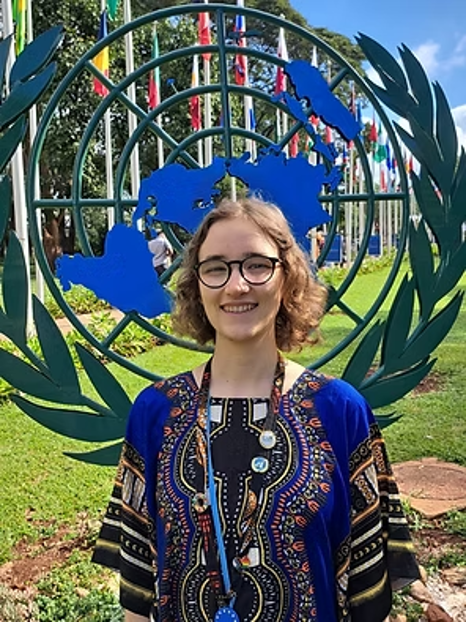
Zuzanna Borowska
A social activist and environmental advocate, dedicated to the values of dialogue, sustainability, and justice. A 2024 graduate of Political Science at the University of Amsterdam, with a specialization in International Relations. Current student of International Economic and Political Studies at the Charles University in Prague. Founder and President of the Open Dialogues International Foundation – a global non-profit organization supporting intercultural dialogue and community action. Main coordinator of all five editions of the Foundation’s flagship project, the Open Dialogues on Climate Change. Member of the third cohort of the United Nations Secretary General’s Youth Advisory Group on Climate Change, serving in 2025 and 2026. A Climate Negotiator representing the Global South, youth, and civil society in the United Nations Framework Convention on Climate Change since 2018, participant of more than 10 UNFCCC negotiating sessions. Lead Negotiator on Just Transition for the Republic of Liberia in 2023, Just Transition and Response Measures Negotiator for the Dominican Republic in 2024. Active Member and former Contact Point on Action for Climate Empowerment and Just Transition in YOUNGO – the Youth Constituency of the UNFCCC. Head Organizer of the first two editions of the Polish Local Conference of Youth (LCOY Poland) in 2019 and 2021. European Climate Pact Ambassador since 2022.
Powiązane artykuły




Jeśli nie zaznaczono inaczej, materiał nie może być powielany bez zgody redakcji.